
GENERAL WINTER: CULTURE BEYOND POLITICS AND THE RUSSIAN WINTER TABLE
- The Epicurer

- 8 dic 2025
- 3 Min. de lectura
One clarification is indispensable. At The Epicurer, we stand firmly against the current invasion of Ukraine. Aggression, revisionist imperial nostalgia, and the violation of sovereignty are incompatible with the cultural, humanistic and intellectual values that guide this maison. But condemning a war is not the same as erasing a civilization. Russian culture—its literature, cuisine, rituals, myths and aesthetics—belongs to a chronology far older and far more nuanced than the political tragedy unfolding today. Our editorial task is to preserve that distinction.
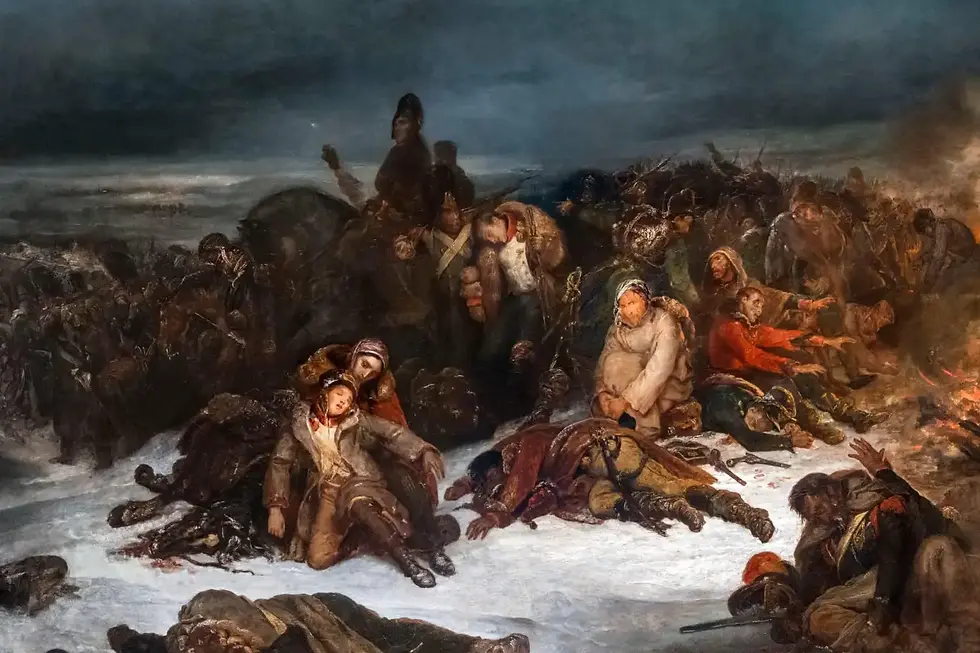
Few ideas embody the Russian imagination as powerfully as the figure known as “General Winter.” More than a metaphor, he is the embodiment of a climate so fierce that foreign invaders believed the land itself was waging war against them. Napoleon discovered him in 1812; Hitler met him in 1941. Winter did what generals could not: it stalled armies, broke morale, and reduced every invading plan to the brutal arithmetic of cold. Yet the myth also shaped daily life. The same force that stopped empires shaped kitchens, rituals and the psychology of survival. Russian winter cuisine did not emerge from comfort—it emerged from necessity. Long, unforgiving winters demanded a culinary philosophy based on preservation, density and fermentation. Autumn harvests had to be transformed into something capable of withstanding months of cold. Pickled cucumbers, fermented mushrooms, salted fish, cured pork, black bread, kvass—these were not trends but technologies of endurance. They allowed families to survive the silence of the snow. In this sense, winter cuisine is not simply a collection of dishes; it is an archive of a people’s confrontation with nature.
Fermentation occupies a special place in that archive. While many cultures ferment, Russia sacralized the process. Brine becomes a living entity, almost a collaborator. Through pickling, summer becomes a memory that can be opened in February. Sauerkraut, solyónye, the sharp tang of kvass—these foods are edible reminders that time can be preserved, not only endured. There is something philosophical in the gesture: an insistence that life can be coaxed into lasting longer than the season that seeks to extinguish it.

Borscht, that shimmering bowl of red, adds another layer of complexity. Today the dish is contested, with Ukraine and Russia each claiming it as their own. Yet borscht transcends borders; it carries the memory of root vegetables, scarcity, and the desire to create warmth from the least luxurious ingredients. It is as much a political symbol as it is a culinary one. The dish unites and divides in equal measure. In moments like these, it reminds us that culture is woven across regions and centuries, while wars are heartbreakingly recent.
Other winter staples—kasha, hearty soups, porridges—reflect the same ethos. Buckwheat porridge, humble and resilient, is the soul of Russian food. It teaches simplicity without shame. Its warmth is moral as well as physical.

Even vodka, so often misunderstood, belongs to this world: not a celebration but a solvent against the cold, a momentary quieting of the chest, a cultural punctuation mark between long silences. Winter shapes more than flavor. It shapes imagination. It produces a certain gravity, a seriousness, a way of seeing the world in terms of endurance rather than display. General Winter is not simply a climatic force, but an aesthetic one—responsible for the introspective tone of Russian literature, the density of its faith, the melancholy of its music, the severity of its landscapes. This is the Russia of Tolstoy’s snow, Tarkovsky’s frozen ponds, Pasternak’s forests in January. This Russia deserves to be understood independently of the geopolitical darkness of the present.

To write about Russian winter cuisine today is to walk a delicate line. On one hand, there is the imperative to name and condemn injustice. On the other, the responsibility to honor a culture that long predates the current violence and will long outlive it. The table is often the last bastion of identity; it preserves what politics erode. Recipes survive where governments fall. Food carries memory where borders fracture.
General Winter, in this sense, is not a general at all, but a custodian. He guards the dishes that sustained families through centuries of uncertainty. He protects the rituals that softened the cruelty of the climate. He reminds us that culture is complex, durable and deserving of respect—even when the political moment is not. And perhaps this is the deepest truth of all: winter cuisine reveals a civilization’s resilience, its imagination, and its capacity to create beauty under pressure. Russia’s winter foods are born from hardship, but they are expressions of tenderness. They are the warm interior against the cold exterior. They are culture as shelter. To appreciate them is not to forget the tragedy unfolding today.It is to remember that a people cannot be reduced to their rulers,and that the integrity of a cuisine may outlast the catastrophes of history.


