
Loomi: The Sun's Long Memory

There is a particular smell that announces itself before the dish does: something sour, faintly smoked, closer to leather than to citrus. It belongs to loomi, the dried black lime that has quietly seasoned the cooking of the Gulf, Iraq, and Iran for centuries, and that Western kitchens are only now learning to pronounce. The transformation begins with an ordinary lime, boiled briefly in salt water, then left in the sun for weeks until the skin blackens and the interior shrinks to something dense and almost mineral. What emerges is not a preserved fruit so much as a different substance altogether. Fresh lime offers brightness; loomi offers depth. The sugars have long since surrendered to fermentation, the acidity has mellowed into something rounder, and a faint smokiness settles in, the residue of sun rather than fire.
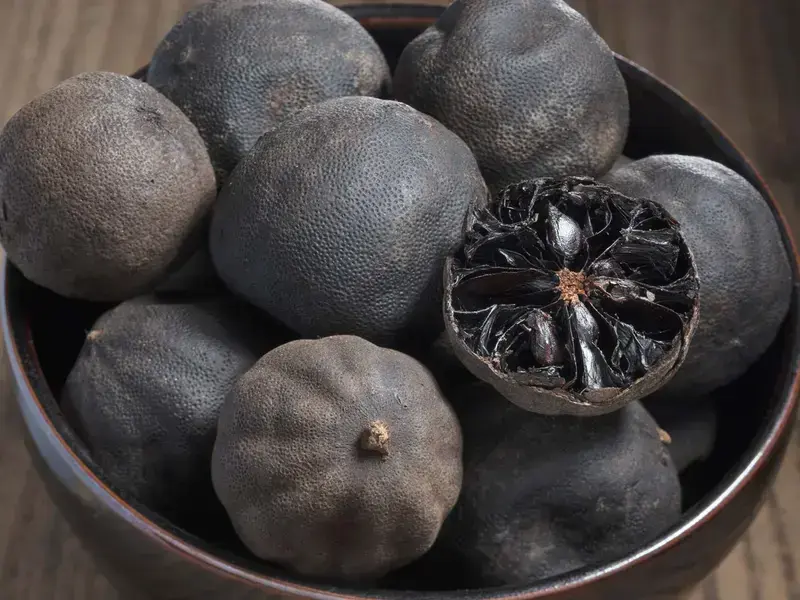
The origins trace to Oman, where the climate and coastal trade routes made large-scale sun-curing both practical and profitable. From there, loomi travelled the dhow routes that connected the Arabian Peninsula to the Persian Gulf and beyond, becoming a fixture of Iraqi cooking (whole, dropped into the pot for a stew like timman bagilla), of Emirati and Bahraini kitchens, and of Iranian cuisine, where it appears ground into khoresh or steeped whole into broths such as ash-e reshteh. Each tradition claims it differently. Iraqis will insist the lime must be pierced before it enters the pot, to release its bitterness gradually rather than all at once. Iranians tend to favour the powder, which disperses more evenly and lends a quieter, more diffuse sourness.
What distinguishes loomi from its more familiar cousins, sumac or fresh citrus, is precisely this refusal to behave like either. Sumac offers a clean, immediate tartness. Fresh lime offers volatility, an acidity that fades the moment it meets heat. Loomi does something stranger: it holds its sourness through hours of simmering, deepening rather than dissipating, until it becomes indistinguishable from the dish itself. This is why it survives so well in the long-cooked, patient food of the region, the stews and braises that ask an ingredient to endure rather than merely announce itself.
For a long stretch of culinary history, loomi remained a regional secret, largely unknown outside the households and restaurants that had always used it. That has changed. A handful of chefs working in Europe and North America, drawn to Gulf and Levantine cooking as a source of technique rather than novelty, have begun reaching for it not as an exotic flourish but as a genuine alternative to citrus and vinegar, a way of introducing acidity that carries weight rather than lift. Used whole, cracked, or ground into a fine dust and dusted over a finished plate, it behaves less like a seasoning and more like an idea: that sourness, properly aged, becomes something closer to memory than to taste.
It would be a mistake, though, to treat loomi's arrival on tasting menus as a discovery. It was never lost. It simply waited, sun-dried and patient, for a wider table to notice what Omani traders and Iraqi cooks had understood for centuries: that the most interesting flavours are rarely the freshest ones, but the ones that have had time to become themselves.


Comments